
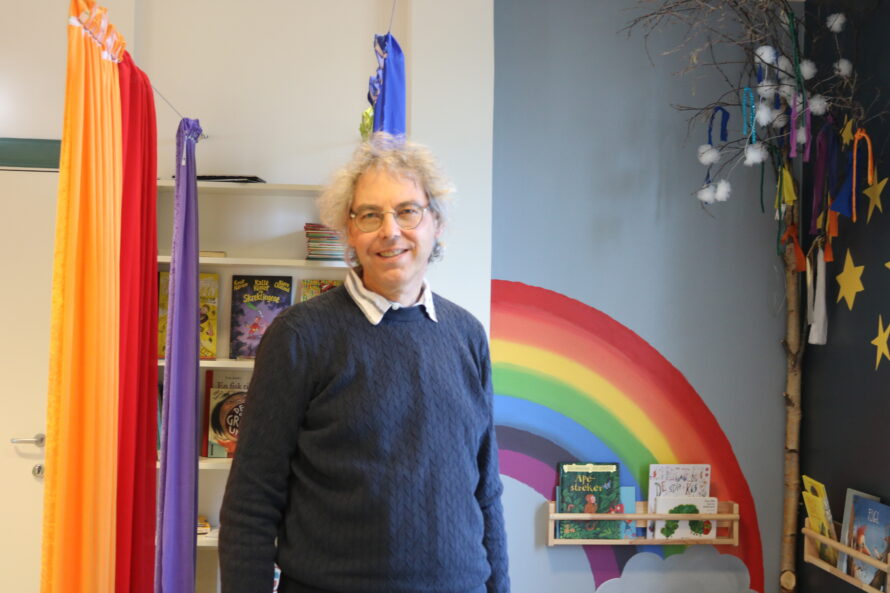
Many people are very nervous in the first math classes. But I have often experienced that students say they didn't like mathematics when they started the course, but now it has become their favorite subject.
Mathematics is about exploring how different things are connected and wondering about it. I think the description in the curriculum is very nice; it's about children searching for connections, in nature, in society, and in the universe. It's mathematics in kindergarten.
Math is more than numbers
Most people think of numbers when they hear mathematics, but it is much more than numbers; it is geometric shapes, it is creative and constructive play, it is exploration and finding patterns. It is patterns that define mathematics as a science. Children learn mathematics by understanding concepts in the world around them.
Exploring space and finding one's place, that is mathematics, such as when children play hide and seek. Then they have to think about where they can hide without being found, and those who search must ask themselves if they have hidden behind something or under something else.
Children are also very concerned with size, another area of mathematics. They themselves are growing. There are many things they can explore and compare, what is small and what is big. And what does it mean that something is big, heavy, tall, wide, thick?
Time is also a mathematical concept. We have a subjective understanding of what time is, but we can also measure it objectively. Often the objective measurement does not match our own perception of time. If you are doing something exciting, you feel that time flies; when doing something boring, it never ends. Comparing the subjective feeling with the objective measurement can be exciting.
Understanding mathematics helps children master life
When you are young, you actually encounter quite a few practical problems, for example, how do I get something I want that is high up, how can I open something to get what is deep inside? Mathematics helps solve such problems.
Fairness is important for children, they are concerned with sharing equally. That is also mathematics. I find that when children play, they are concerned that it should be equal and that everyone gets the same number of chances.
Filming the theory
There is some theory in the education, but we have made many films that convey this. Thus, we have more time to do as many practical things as possible in the teaching hours. Students themselves explore what they can do with shapes, explore space, and so on, in a childlike manner.
In addition, we have many projects. Students make films with shapes, and we have collaborated with art and crafts to create Landart and other art projects. We also collaborate with other subjects, for example, Norwegian, where students are to create poems. There is a lot of mathematics and patterns in the rhymes and rhythms of the poems.
Visit from kindergarten children
At the campus in Trondheim, we have a large room filled with equipment that children like to play with. We have a large climbing frame with a shop counter underneath, we have building blocks and many things in different shapes, sizes, and materials.
Here, we receive visits from kindergartens that come to play in the Mathematics Room almost every day. We ourselves use it in teaching with the students so that they can try out things they would otherwise have done in kindergarten. We have a lot of material we can use for practical activities, and sometimes we also invite the children into the teaching.