

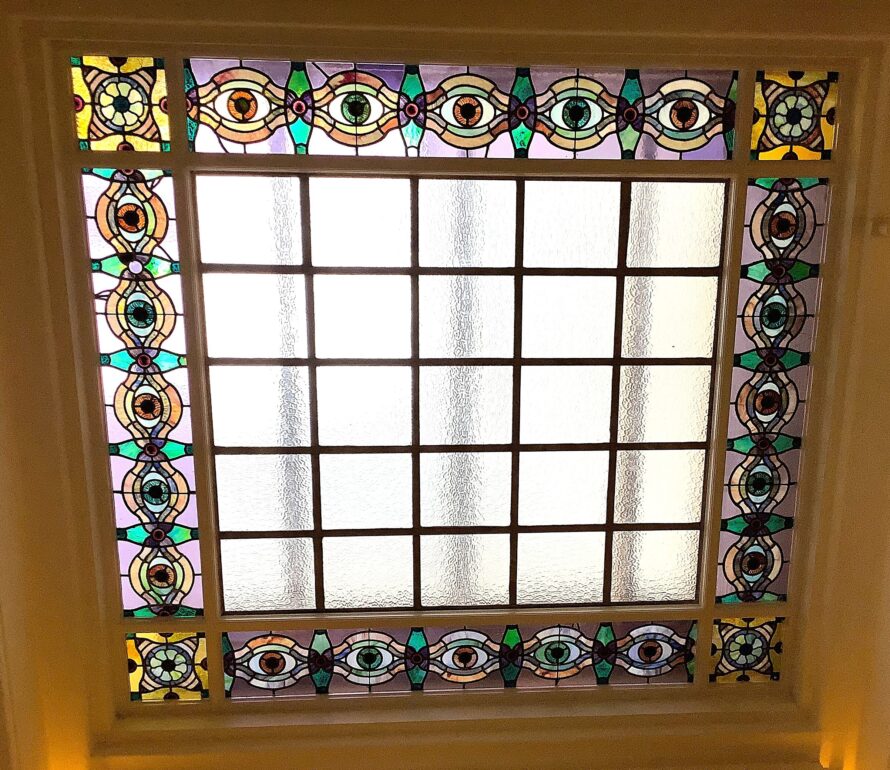
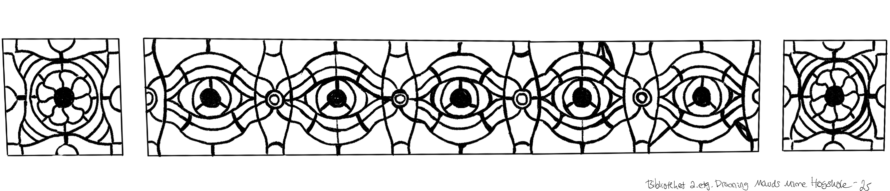
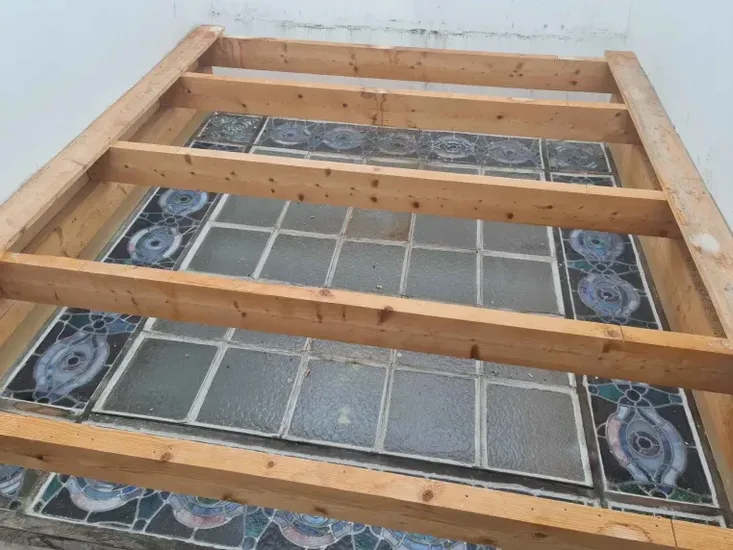
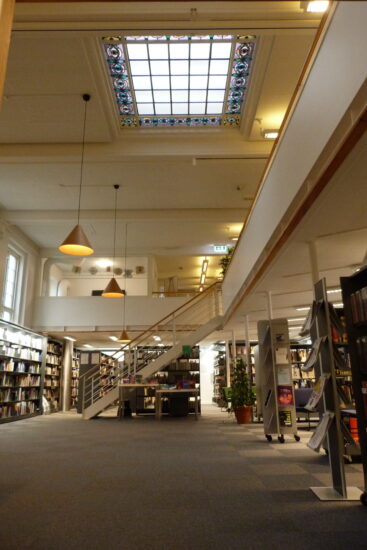
The windows are a pair of two with identical eye motifs created similarly to the Art Nouveau style. This was Johan Osness' specialty. The motifs are in a repeated geometric pattern with green and orange eye colors. The glass is installed in small iron panes and is held in place by a thick wooden frame.
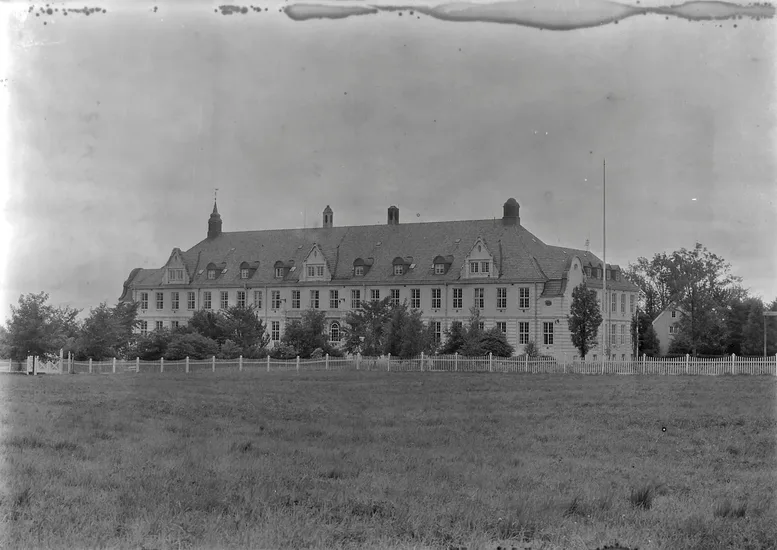
The windows were installed together with the building in 1912 and can be seen on many old photographs from the school's history. The artist and craftsman behind the windows are currently unknown.

Osness used stained glass in many of his buildings. At E. C. Dahls stiftelse, the windows were produced by order from Ferdinand Müller in Germany. Some claim the the windows at DMMH were drawn by Gabriel Kielland, but we do not have any written sources confirming it. Gabriel Kielland is best known for his beautiful stained glass moseac in the Nidaros Cathedral.
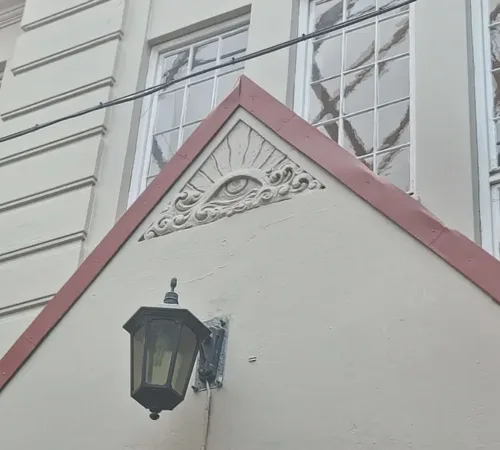
The architect Johan Osness was focused on motifs when he designed his buildings. He made no exception when he handed in his draft for the architect competition for a new school for the blind in 1909.
The building was to serve Dalen Blindeskole (Dalen school for the blind), and the decorative elements were carefully chosen to reflect the people who would live here.
The decorative eyes you see above the main entrances are examples of this.
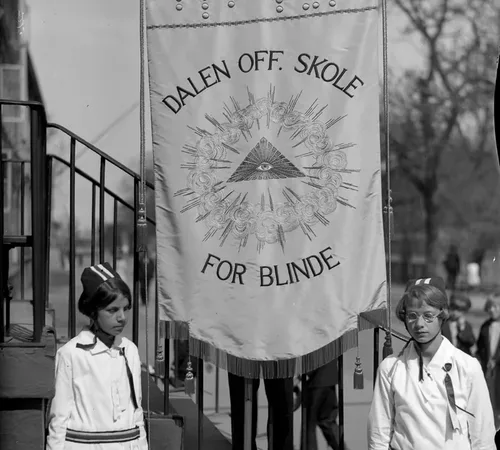
The eye was also a central motif in the school's banner (right). The motif is "God's eye" inside a triangle which shines through the clouds [1]. Atop the banner "Bli lys" (Let there be light) is written in braille.
On the back of the banner is an inscription from the teacher Erik Harildstad: "Mot lyset fremad hånd i hånd, mot lysets seier i vår ånd" (Towards the light hand in hand, towards the light's victory in our souls).
A committe made up by the teachers Valborg Wexelsen, Ingeborg Ingvaldsen and the director Johan Voll [2] lead the work to create the banner. The banner was officially revealed on the 17th of May 1932.
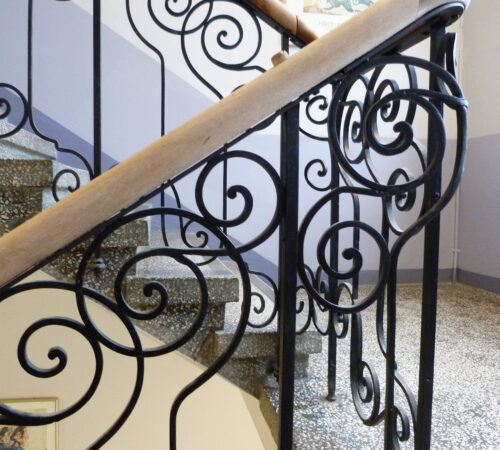
Art Nouveau Decor
Dalen school for the blind was drawn in a newer style, often called Nordic New Baroque[3]. While Osness is most known as an Art Nouveau architect, he moved into the baroque style during the 1910s. Despite this, we still see some features of Art Nouveau in the building.
He primarily used geometric shapes, elements from the natural world and his unique swirld-decor in this building (left). As most architects of this period did, Osness drew and designed a large portion of the interior. These are still in place today.
Osness was a man with a heart for decor. Even when he constructed modern buildings with high levels of symmetry and smooth surfaces, he still went outside the box and added small details and patterns. This is especially visible in the staircases.
Photo archive:

Contact:

Do you have information about Johan Osness and Dalen Blindeskole?
This project is ongoing and is dependent on documents and sources which may be stored in private archives. Contact me if you think you may be in posession of relevant documents.